The Palaces and Castles of Sintra Portugal
Six monuments on one hillside, built a thousand years apart. Here is what each one actually is, and which two to pick.
Six monuments, three owners and one hillside — and a sintra castle tour that reaches two of them in a morning. Sintra's palaces were built across a thousand years for entirely different reasons, and they reward entirely different visitors. This is what each one actually is, what it costs, and how long it takes.
Pena Palace — Ferdinand II's Romantic hilltop, 1842 to 1854
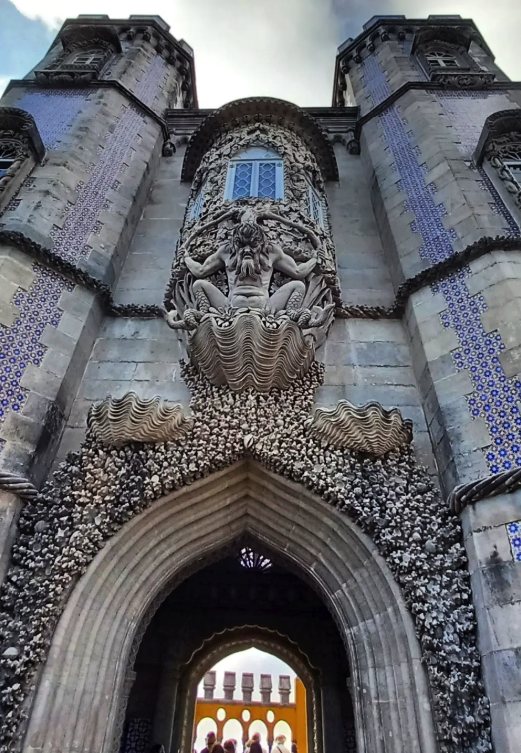
King Ferdinand II bought a ruined Hieronymite monastery on the highest point of the Serra in 1838 and spent sixteen years turning it into something that had never existed before. The architect was Wilhelm Ludwig von Eschwege, a German mining engineer. The result puts neo-Gothic, neo-Manueline and neo-Moorish work on the same building and paints it ochre and vermilion.
The monastery is still inside it — the cloister and the chapel are original, and the earthquake of 1755 is why they were available to build on. UNESCO's 1995 citation names this building as the start of European Romantic architecture. It was voted one of the Seven Wonders of Portugal in 2007.
Adult entry €20 for the Essential Visit, covering the interior and the park; €12 for the park alone. Allow two hours, thirty minutes of which is the walk up.
Quinta da Regaleira — Carvalho Monteiro's initiation garden, 1904 to 1910
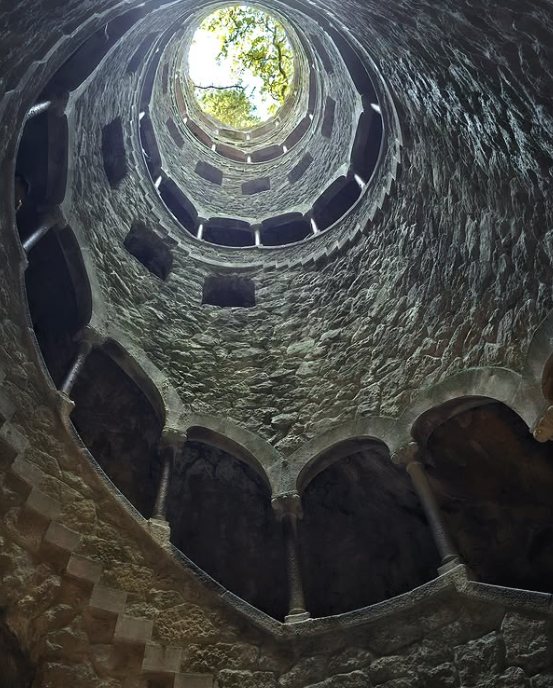
António Augusto Carvalho Monteiro bought four hectares below the town in 1892 and hired Luigi Manini — an Italian opera set designer — to build a garden about initiation. It is the most deliberate thing in Sintra: every grotto, tower and tunnel is placed to mean something.
The Initiation Well is why most people come. A 27-metre shaft, nine flights of spiral steps, 23 niches, and a Templar cross set into the floor at the bottom. It is not a well and never held water. Tunnels lead out of it and surface beside a waterfall, which is the best five minutes in Sintra.
Adult entry €15, on timed slots, last entry 16:30. Allow 90 minutes. The estate opened to the public only in 1998, after the town council bought it.
The Castle of the Moors — an 8th-century ridge fortress
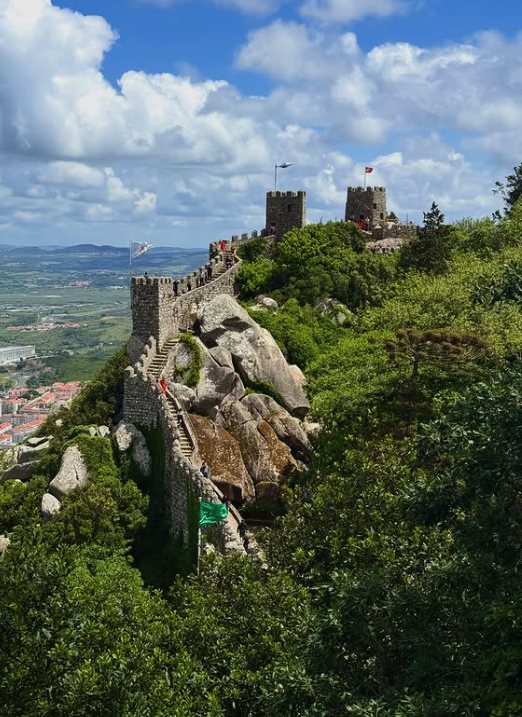
Built by the Moors in the 8th and 9th centuries to watch the coast and the road to Lisbon, and taken by Christian forces after Lisbon fell in 1147. What survives is the wall — a rampart that runs the ridge with towers at the high points.
There is no interior. This is a walk on a wall, with the Atlantic on one side, Pena on the other and the whole plain toward Lisbon below. In clear weather it is the best view in the region. In cloud it is a wall in cloud, which is its own thing.
Adult entry €12. Allow an hour. Uneven stone and steps throughout, so this is the one to skip if the ground is a problem.
The National Palace of Sintra — the twin chimneys
The two white cones over the kitchens are the shape everyone photographs without knowing what they are: chimneys, 33 metres tall, over the kitchens that fed a royal court. This is the oldest surviving royal palace in Portugal, in continuous royal use from the 15th century to 1910, and it sits directly on the main square rather than up a hill.
Inside, the Magpie Room and the Coats of Arms Room carry painted ceilings that have no equivalent anywhere. The Arab Room and the tilework throughout are the clearest surviving record of Moorish craft under Portuguese kings.
Adult entry €13; the gardens are free. Allow 45 minutes. It is the easiest monument in Sintra to reach and the most often skipped.
Monserrate — the palace at the end of the valley
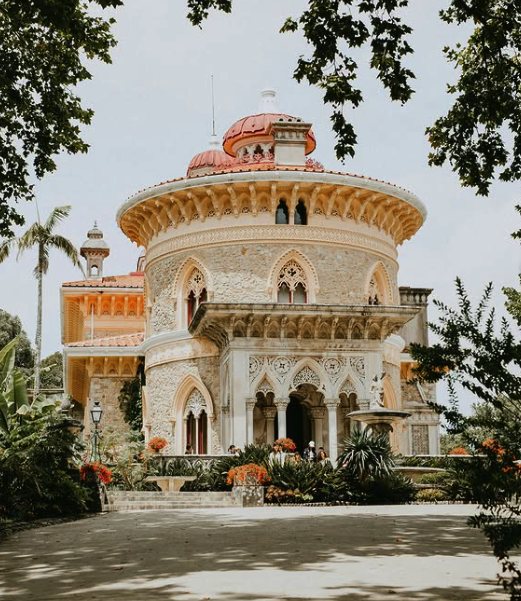
Four kilometres west of the town, and quiet because of it. A 19th-century summer palace built for the English merchant Francis Cook, with a plaster-and-stone interior that borrows from Mughal India and Moorish Iberia at the same time.
The gardens are the point: a botanical collection laid out across a valley, with Mexican, Australian and Japanese sections that were planted when that was a radical idea. Roof restoration runs into early 2027, so expect scaffolding on the building.
Adult entry €12 for park and palace. Allow 90 minutes. The 435 bus is the way there without a car.
The Chalet of the Countess of Edla
Inside Pena's park, and included in the Pena ticket, which is why it is the most overlooked building in Sintra. Ferdinand II built it in the 1860s with his second wife, Elise Hensler, the Countess of Edla — a Swiss-American opera singer.
It is an alpine chalet with cork-clad walls, built as a private retreat rather than a statement, and it survived a fire in 1999 to be restored. If you have already paid to enter the park, walking down to it is free and takes twenty minutes.
The Convent of the Capuchos — cork cells in the forest
Eight kilometres west, and the opposite of everything else on this list. Franciscan friars founded it in 1560 and lined its cells with cork against the damp — tiny rooms cut into the rock, with doorways low enough to make you stoop.
It is the quietest place in the Serra and the one that most surprises people who came for palaces. Visitor numbers are capped, so book ahead. Reaching it needs a car or a tour; neither the 434 nor the 435 goes there.
Which two to choose if that is all you have time for
Almost nobody manages more than two properly in a day. Pick by what you actually want rather than by fame.
| If you want… | Choose | Then add | Why |
|---|---|---|---|
| The famous one | Pena Palace | The Castle of the Moors | They share a hilltop and one bus stop, so the pairing costs no travel time |
| Gardens and atmosphere | Quinta da Regaleira | Monserrate | Both are garden estates; the 435 links them |
| The least walking | National Palace | Quinta da Regaleira | Both sit in or beside the historic centre |
| Photographs | Pena Palace | Cabo da Roca | The ridge in the morning, the Atlantic cliffs in the afternoon |
| A day with children | Quinta da Regaleira | Pena park | Tunnels, a well and open ground rather than roped-off rooms |
Let a guide handle the hill
Guided days pair the monuments that work together and drive between them, which is the part the buses make hard.
Things to do in Sintra covers what fills the gaps between monuments, the history of Sintra explains why they all ended up on one hillside, and Sintra Portugal Tours lists the guided options with what each fare covers.