Sintra Portugal Palace by Palace: What to See Inside
The short answer
Pena Palace is the one everyone comes for and deserves two hours. Quinta da Regaleira is the one people are surprised by and deserves 90 minutes. The Castle of the Moors is a rampart walk with the best view in the region. The National Palace is the easiest to reach and the most often skipped. Pick two.
Sintra's monuments were built across a thousand years by people with nothing in common except the hillside. Walking them in the wrong order, or giving the wrong one your best hours, is the difference between a good day and a rushed one. Here is what is actually inside each.
Pena Palace — two hours, and thirty minutes of that is the walk
King Ferdinand II bought a ruined Hieronymite monastery on the highest peak of the Serra in 1838. Between 1842 and 1854 he and Wilhelm Ludwig von Eschwege, a German mining engineer, built around it: neo-Gothic, neo-Manueline and neo-Islamic work on one building, painted ochre and vermilion.
What to look for inside
- The Manueline cloister — original 16th-century monastery fabric, and the quietest part of the building.
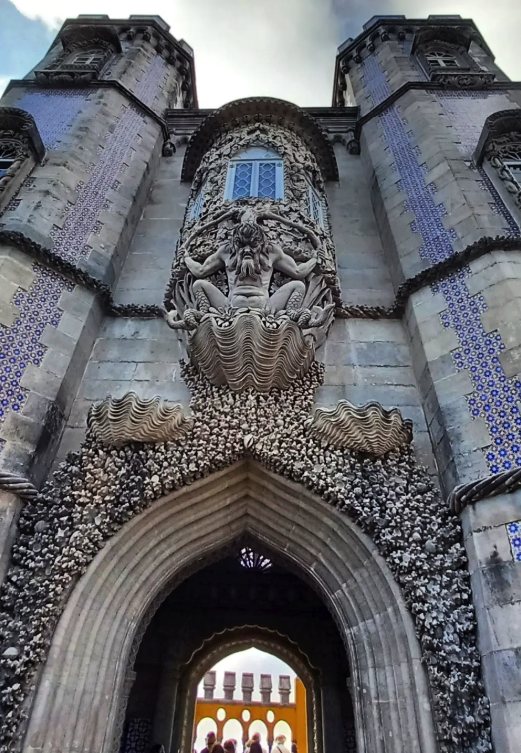
- The Triton gateway — a half-man, half-fish figure over the arch, the most photographed detail on the facade.
- The Arab Room — trompe-l'oeil stucco that reads as carved stone until you are close enough to doubt it.
- The Great Hall — the chandelier and the stained glass, and the room that stops the queue moving.
- The kitchen — copper laid out as it was left, and the most human room in the palace.
Allow two hours. Adult €20 for the Essential Visit, €12 for the park alone. The park is 200 hectares of Ferdinand's planting, and the Chalet of the Countess of Edla sits inside it on the same ticket.
Quinta da Regaleira — the garden built as an argument
António Augusto Carvalho Monteiro bought four hectares below the town in 1892 and hired Luigi Manini, an Italian opera set designer, to build a garden about initiation. Construction ran from 1904 to 1910. It opened to the public only in June 1998.
What to look for
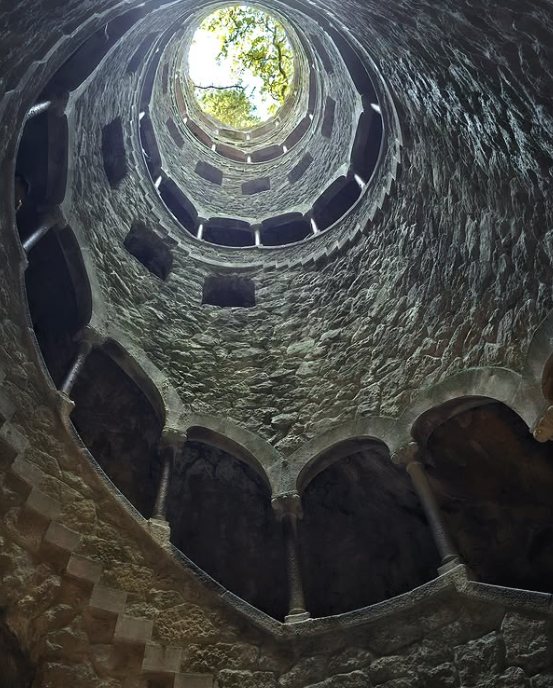
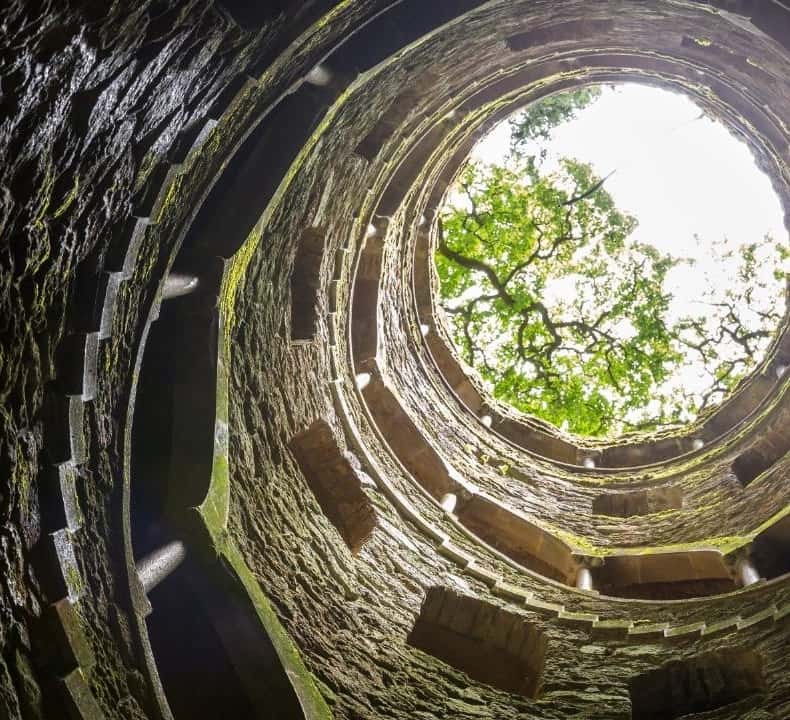
- The Initiation Well — 27 metres deep, nine flights of spiral steps, 23 niches, and a Templar cross set into the floor at the bottom. It never held water.
- The tunnels — unlit passages leading out of the well, surfacing beside a waterfall and stepping-stones.
- The Regaleira Tower — a short climb for the best view of the estate and the town beyond it.
- The Chapel — small, dense with symbolism, and usually empty because everyone is queueing for the well.
- The palace itself — the least remarkable thing on the estate, which tells you something about Monteiro's priorities.
Allow 90 minutes. Adult €15, on timed slots, last entry 16:30. Go first thing: the well is a single-file staircase and it does not cope with a crowd.
The Castle of the Moors — a wall, and the best view in the Serra
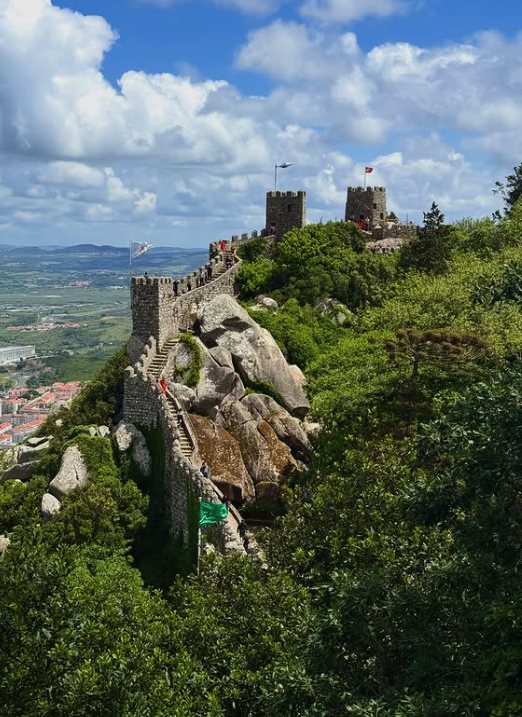
Built by the Moors in the 8th and 9th centuries as a lookout over the coast and the road to Lisbon, and taken by Christian forces after Lisbon fell in 1147. There is no interior to tour. What survives is the wall itself, following the ridge with towers at the high points.
On a clear morning you can see the Atlantic on one side, Pena on the other, and the plain running toward Lisbon below. In cloud you can see about nine metres, which is its own kind of experience. Uneven stone and steps throughout.
Allow an hour. Adult €12. It shares a hilltop and a bus stop with Pena, so the two pair naturally — see the palaces and castles of Sintra for the pairings that work.
The National Palace of Sintra — the twin chimneys
The two white cones over the kitchens are 33 metres tall and have marked the centre of Sintra since the Middle Ages. This is the oldest surviving royal palace in Portugal, in continuous royal use from the 15th century to 1910, and it sits on the main square rather than up a hill.
What to look for
- The Magpie Room — 136 magpies painted on the ceiling, each with a rose and a motto, reputedly João I's answer to a gossiping court.
- The Coats of Arms Room — a domed ceiling of 72 noble family arms.
- The Swan Room — 27 swans on the ceiling, each in a different posture.
- The kitchens — you stand inside the base of those chimneys.
Allow 45 minutes. Adult €13; the gardens are free. It is the easiest monument in Sintra to reach and the one most day trips leave out.
Monserrate — the quiet one
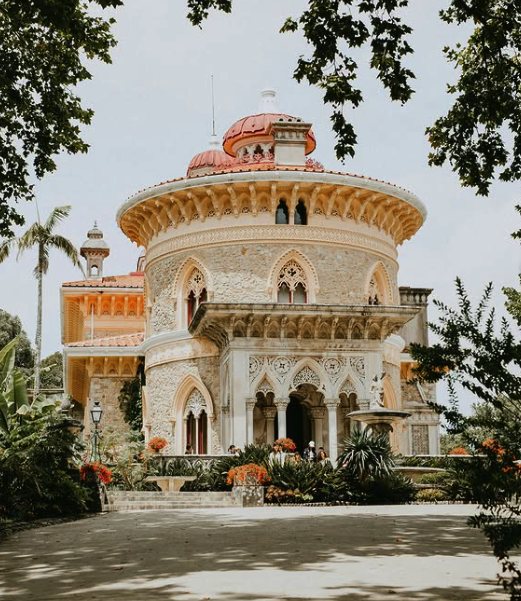
Four kilometres west of the town. Francis Cook, an English textile merchant, rebuilt it from 1858 with an interior that borrows from Mughal India and Moorish Iberia at once, and planted a botanical garden across the valley below.
The gardens are the reason to come — Mexican, Australian and Japanese sections laid out when that was a radical idea. Roof restoration continues into early 2027, so expect scaffolding. Allow 90 minutes; adult €12. The 435 bus goes there.
The Chalet of the Countess of Edla — the one nobody walks to
It sits inside Pena's park and it is covered by the Pena ticket, which is why it is the most overlooked building in Sintra. Ferdinand II built it in the 1860s with his second wife, Elise Hensler, a Swiss-American opera singer who became the Countess of Edla.
It is an alpine chalet with cork-clad walls and painted interiors, built as a private retreat rather than a statement. Fire gutted it in 1999 and it was restored over the following decade. From the palace it is a twenty-minute walk downhill through the park, and almost nobody makes it. If you have paid the €20 anyway, it is the best free thing in Sintra. Things to do in Sintra covers the rest of the park.
What each one asks of your legs
| Monument | Ground | Steps | Honest verdict |
|---|---|---|---|
| Pena Palace | Made paths, then cobbles | Some inside | The 30-minute approach is the hard part; take the shuttle |
| Pena park | Made paths, gently graded | Few | The most accessible ground in Sintra |
| Quinta da Regaleira | Garden paths, some rough | Many, and the well is steps only | Fine for most; the well is not step-free |
| Castle of the Moors | Uneven stone throughout | Constant | Skip it if steps are a problem |
| National Palace | Level, in the town | Interior stairs | The easiest of the five to reach |
| Monserrate | Valley paths, sloped | Some | Gentler than it looks from the gate |
The Parques de Sintra sites publish access information for each monument, and Sintra ticket prices and opening hours covers what the walking is really like before you commit a day to it.
The order to walk them in
| If you have | Morning | Afternoon | Why this order |
|---|---|---|---|
| One day, two monuments | Pena Palace | Quinta da Regaleira | Pena's early slots are the ones worth having |
| One day, the view | Castle of the Moors | Pena Palace | Both on one hilltop; the ridge is clearest early |
| Half a day | Quinta da Regaleira | Historic centre | Both walkable from the station, no bus needed |
| A day with children | Quinta da Regaleira | Pena park | Tunnels first, while energy lasts |
| Two days | Pena and the Moors | Regaleira, then Monserrate | Splits the hill climbs across two mornings |
Seeing them with a guide
The monuments are a short distance apart and a long way apart, which is the whole problem. A guided day handles the driving and the timed slots; a private day rebuilds the route around whichever of these you actually want.
For what each monument costs and when it opens, see tickets and hours. For how the buildings ended up here at all, the history of Sintra covers the thousand years behind them, and Sintra Portugal Tours lists every guided option.
See two properly rather than four badly
The guided days pair the monuments that work together. Compare them under Sintra Portugal tours and tickets.
Tours that fit this trip
Chosen to match the day described above, not for what sells.
Lisbon: Sintra, Pena Palace, Moorish Castle & Regaleira Tour
Pena Palace, the Castle of the Moors and Quinta da Regaleira in one guided day, at an hour and a half each.
From $144 per person
Check Availability
Small Group Tour to Sintra, Pena Palace, Cabo Roca and Cascais
A group of eight, hotel pickup and an hour and a half at Pena Palace and its park before the coast.
From $82 per person
Check Availability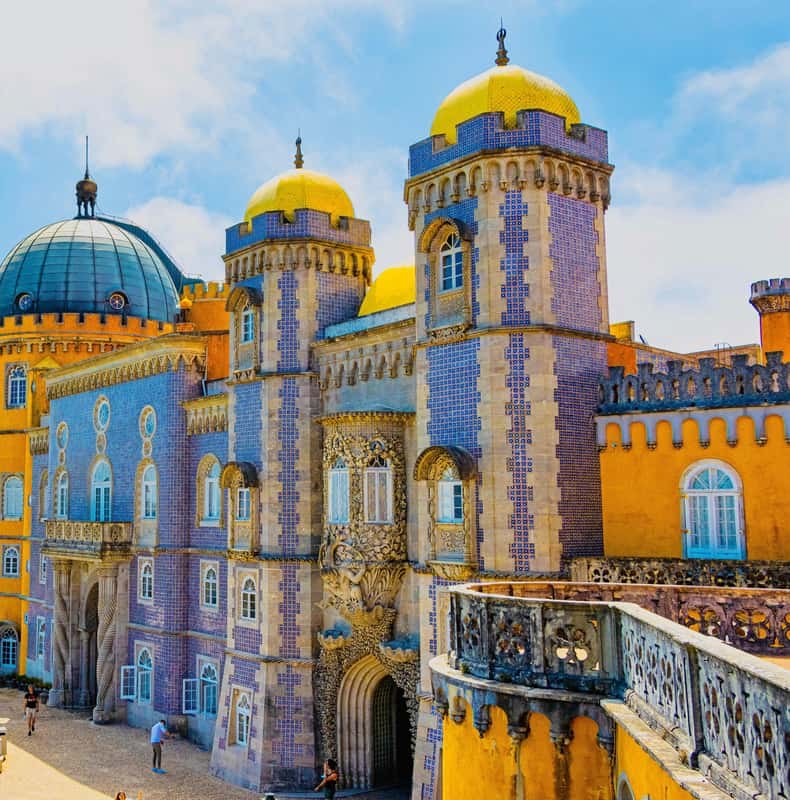
Lisbon: Sintra, Pena, Regaleira, Cabo & Cascais Tour
Pena guided, an hour in its gardens and Quinta da Regaleira on the option that adds it.
From $82 per person
Check Availability