Surprising Facts About Sintra Portugal
The short answer
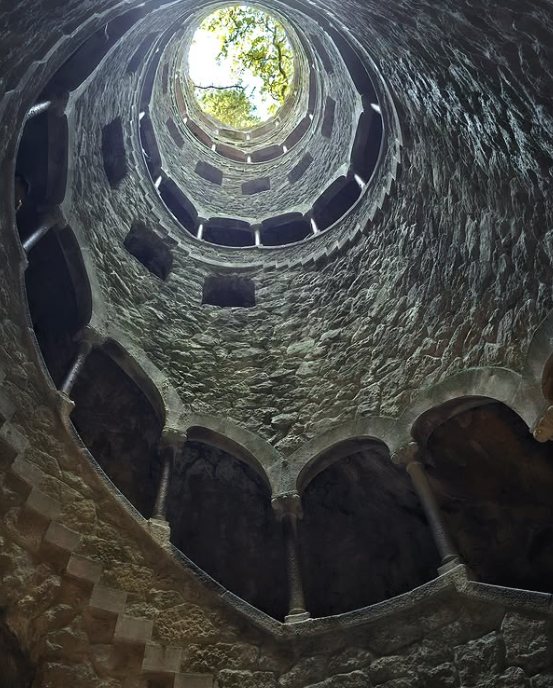
Pena Palace is built around a 16th-century monastery the 1755 earthquake destroyed. Quinta da Regaleira was designed by an opera set designer. The Initiation Well never held water. And the reason anything got built on this hillside at all is a microclimate that makes its own weather.
Sintra is well photographed and badly explained. Most of what makes it strange is not visible from the terrace everyone stands on. These are the facts that change what you are looking at.
1. There is a monastery inside Pena Palace
King Manuel I founded a Hieronymite monastery on the peak in 1503. It stood for 250 years until the Lisbon earthquake of 1 November 1755 reduced it to a chapel and a cloister inside a ruin. Nobody rebuilt it.
That abandonment is exactly why the site was available and cheap when Ferdinand II went looking in 1838. The Manueline cloister you walk through in the middle of the palace is the original building. Portugal's most photographed facade is wrapped around a wrecked monastery.
2. The most famous garden in Sintra was designed by a set designer
Luigi Manini, who built Quinta da Regaleira for António Carvalho Monteiro between 1904 and 1910, was a scenographer at La Scala in Milan. He designed opera sets for a living.
It explains everything about the estate. The sightlines, the reveals, the way a path turns and hands you a view — these are stagecraft, not landscape gardening. You are walking through a set built at full scale and left standing.
3. Byron called it a glorious Eden and the town has never let it go
Byron reached Sintra in 1809 and put it into Childe Harold's Pilgrimage. The phrase has been on tourist literature ever since. What actually mattered was the effect: wealthy foreigners started buying hillside, and the estates that define Sintra today — Monserrate, Regaleira, Seteais — all follow from that fashion.
4. Sintra makes its own weather
The Serra de Sintra rises straight off the Atlantic and catches the moisture coming in. The town runs several degrees cooler than Lisbon, holds cloud when the coast is clear, and supports plants that have no business growing at this latitude.
That microclimate is not a footnote, it is the reason for everything. Portuguese kings summered here because it was cool. Ferdinand II could plant tree ferns and North American conifers on a Portuguese hilltop because it is wet. Bring a layer, and see when to visit Sintra for what the ridge does to a forecast.
5. Sintra was the first cultural landscape UNESCO ever listed in Europe
The inscription came in 1995, under criteria (ii), (iv) and (v), covering 946 hectares with a buffer zone of 3,641. The category matters: Sintra was listed not as a set of buildings but as a landscape where architecture and planting were designed together.
UNESCO's own citation credits Sintra as the first centre of European Romantic architecture, and says its parks and gardens influenced landscape architecture across the continent. That is an unusually strong claim in a World Heritage listing.
6. The Moorish castle was already ancient when the kings arrived
The ramparts on the ridge went up in the 8th and 9th centuries. Lisbon fell in 1147 and Sintra surrendered shortly after, without a siege. By the time Portuguese royalty was building in the valley below, the fortress above them was already four centuries old and functionally obsolete.
It spent most of its later life as a picturesque ruin, which is precisely what made it attractive to the Romantics. Ferdinand II had it consolidated as part of the same project that produced Pena. The history of Sintra follows the whole sequence.
7. The pastry has been made in the same street since 1862
Casa Piriquita on Rua das Padarias has sold travesseiros — puff pastry folded seven times around an egg-and-almond cream — since 1862. The queijada de Sintra, a small cheese tart, is older still and was being made here in the Middle Ages.
Most guided departures stop at Piriquita for exactly this reason, and it is worth the five minutes. Things to do in Sintra covers the rest of the town.
8. Queen Amélia's last night in Portugal was spent at Pena
The revolution of October 1910 ended the monarchy. Portugal's last queen spent her final night in the country at Pena Palace before leaving for exile, and the building was classified a national monument and turned into a museum immediately afterwards.
The palace you tour has been a museum for longer than it was ever a royal residence — 116 years against 56.
9. Ferdinand II turned a bare hillside into a forest
The Serra around Pena was largely bare rock and scrub when Ferdinand bought it. The 200 hectares of woodland the palace now sits in were planted deliberately, with species brought in from North America, Australia, New Zealand, China and Japan.
Tree ferns, sequoias and camellias grow there because the Atlantic microclimate lets them. It is one of the earliest examples anywhere of a landscape designed as a single composition with a building — and it is why UNESCO listed Sintra as a cultural landscape rather than a set of monuments. The palaces and castles of Sintra covers the park alongside the building.
10. The most interesting estate was private until 1998
Quinta da Regaleira stayed in private hands for most of the 20th century. The Sintra town council bought it in 1997 and opened it to the public in June 1998 after restoration.
Anyone who visited Sintra before the late nineties saw a completely different town from the one on the postcards now.
| The claim | The fact |
|---|---|
| Pena is a medieval castle | Built 1842–1854, on a 1503 monastery site |
| The Initiation Well is a well | Never held water; built for ceremony |
| Regaleira is a royal palace | Built for a private millionaire, 1904–1910 |
| Sintra is a suburb of Lisbon | A separate town, 28 km away, with its own climate |
| The Moorish castle is a ruin | A consolidated 8th-century rampart you can walk |
Where to see each of these
- The monastery cloister — inside Pena Palace, on the Essential Visit ticket. Look for the Manueline vaulting.
- Manini's stagecraft — the whole of Quinta da Regaleira, best read by walking the paths in the order the signage suggests.
- The Templar cross — at the bottom of the Initiation Well, under your feet.
- The microclimate — the tree ferns in Pena's park, which should not grow at this latitude.
- The Moorish wall — the Castle of the Moors, a €12 ticket and an hour.
- The pastry — Casa Piriquita on Rua das Padarias, two streets from the main square.
When to visit covers the light and the fog, and the Sintra FAQs answers the practical questions these raise.
Hearing the rest of it on site
Guides on the small-group and private days spend their time on exactly this material, and it is why a guided day reads differently from an audio guide. For what each monument is, see the palaces of Sintra; for the practicalities, tickets and hours; and Sintra Portugal Tours lists every guided option from Lisbon.
Hear the rest on the hill
Guides spend their day on this material. Browse the guided Sintra Portugal tours that include the monuments in this guide.
Tours that fit this trip
Chosen to match the day described above, not for what sells.
Private Sintra Tour Palaces and Coast by Vintage Car or Jeep
Three hours driving the Serra by vintage car or jeep, past the Castle of the Moors and Chalet Biester.
From $82 per person
Check Availability
Lisbon: Pena Palace, Moorish Castle, Qta. Regaleira & Sintra
Five and a half hours across three monuments, with a guided visit inside and a booklet in four languages.
From $113 per person
Check Availability
Lisbon: Half-Day Sintra Tour with Pena Palace and Regaleira
Pena and Regaleira guided in half a day, with the local sweets that started in the town in 1862.
From $91 per person
Check Availability